MyNCWIC Portal
Visit the MyNCWIC Portal Page to upload documentation, answer health questions, request a new appointment, and communicate with your WIC clinic or find information here: Sign up for the MyNCWIC Portal
Online Education
Access free online nutrition lessons for WIC participants at wichealth.org
Access free online breastfeeding classes for WIC participants at Ready Set Baby
Breastfeeding Support
For additional 24 hour breastfeeding support, check out the Appalachian Breastfeeding Network to access their 24 hour breastfeeding hotline by calling 888-588-3423 or texting BFHOTLINE to 220-201-5477 to connect with a lactation professional and/or explore UNC Health’s breastfeeding support page for additional resources including their breastfeeding warm line at 866-428-5608.
Additional Assistance
To apply for Medicaid, FNS, Energy Assistance, or TANF-Work First visit NC ePass
View the Notice of Free Interpretation and Available Assistance Services.
WIC provides foods that are good sources of many needed nutrients. They include:
- milk
- cereal
- fresh fruits
- fresh veggies
- eggs
- infant formula
- infant cereal
- cheese
- peanut butter
- juice
- dry beans, peas, lentils
- whole wheat bread
- brown rice
- soft corn or whole wheat tortilla
- tuna/salmon*
- infant fruit & vegetables
- infant meats*
*for breastfeeding women only
Shopping Resources
- WIC Grocers and Free-standing Pharmacies
- ebtEDGE App Handout for NC eWIC | ebtEDGE para NC WIC
- EBT Edge Portal
- NC WIC Program Shopping Guide (English) | NC WIC Program Shopping Guide (Español)
Need Help?
Call eWIC Customer Service at (844) 230-0813
Check out helpful shopping videos on Welcome to NC WIC Videos and tips for using your eWIC card at eWIC for Families.
WIC clients and family members receive more than food. They get:
- Access to Basic Nutritious Foods
- Nutrition Education
- Health Care Referrals
- Breastfeeding Promotion and Support to include breastfeeding peer counselor support program for mother-to-mother counseling, consultation with trained designated breastfeeding experts and breastfeeding aids such as manual and electric breast pumps.
Visit My WIC to find out more information about the WIC Program and Services.
Visit My WIC to find out more information about the WIC Program Eligibility.
WIC is available to pregnant, breastfeeding and postpartum women, infants and children up to age five. Foster families with qualifying individuals may be eligible to receive WIC benefits. To participate, these persons must:
- Live in North Carolina.
- Be at nutritional risk. A nutritionist or other health professional makes the nutritional risk assessment at no cost to the participant.
- Have a family income less than 185% of the U.S. Poverty Income Guidelines. A person receiving Medicaid, Temporary Assistance for Needy Families (TANF), or assistance from the NC Food and Nutrition Services automatically meets the income eligibility requirement. See the income eligibility chart below.
Income Eligibility Chart (Effective June 2, 2025)
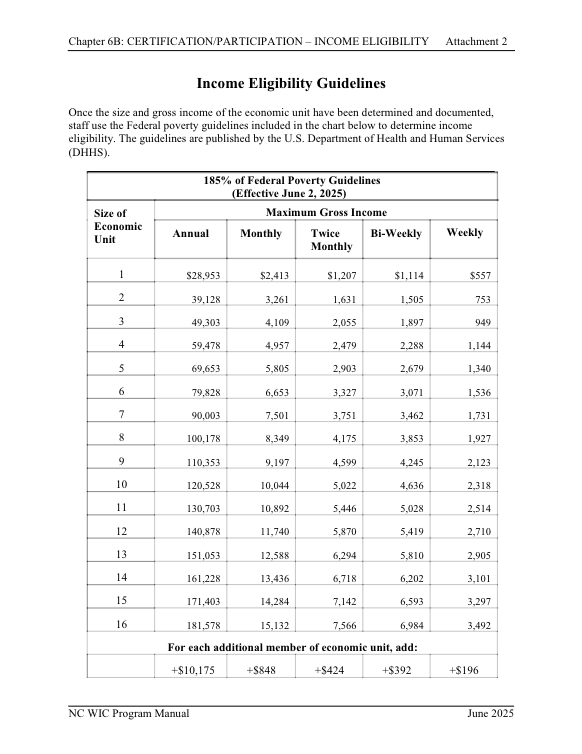
Note: A person who currently receives Medicaid, Work First, or Food and Nutrition Services (Food Stamps) automatically meets the income eligibility guidelines for WIC.
*185% of the Federal Poverty guidelines per the Federal Register.
** A household (or economic unit) is defined as a person or group of persons, related or nonrelated, who usually (although not necessarily) live together, and whose production of income and consumption of goods or services are related. The income of everyone in the economic unit is counted to determine eligibility.